



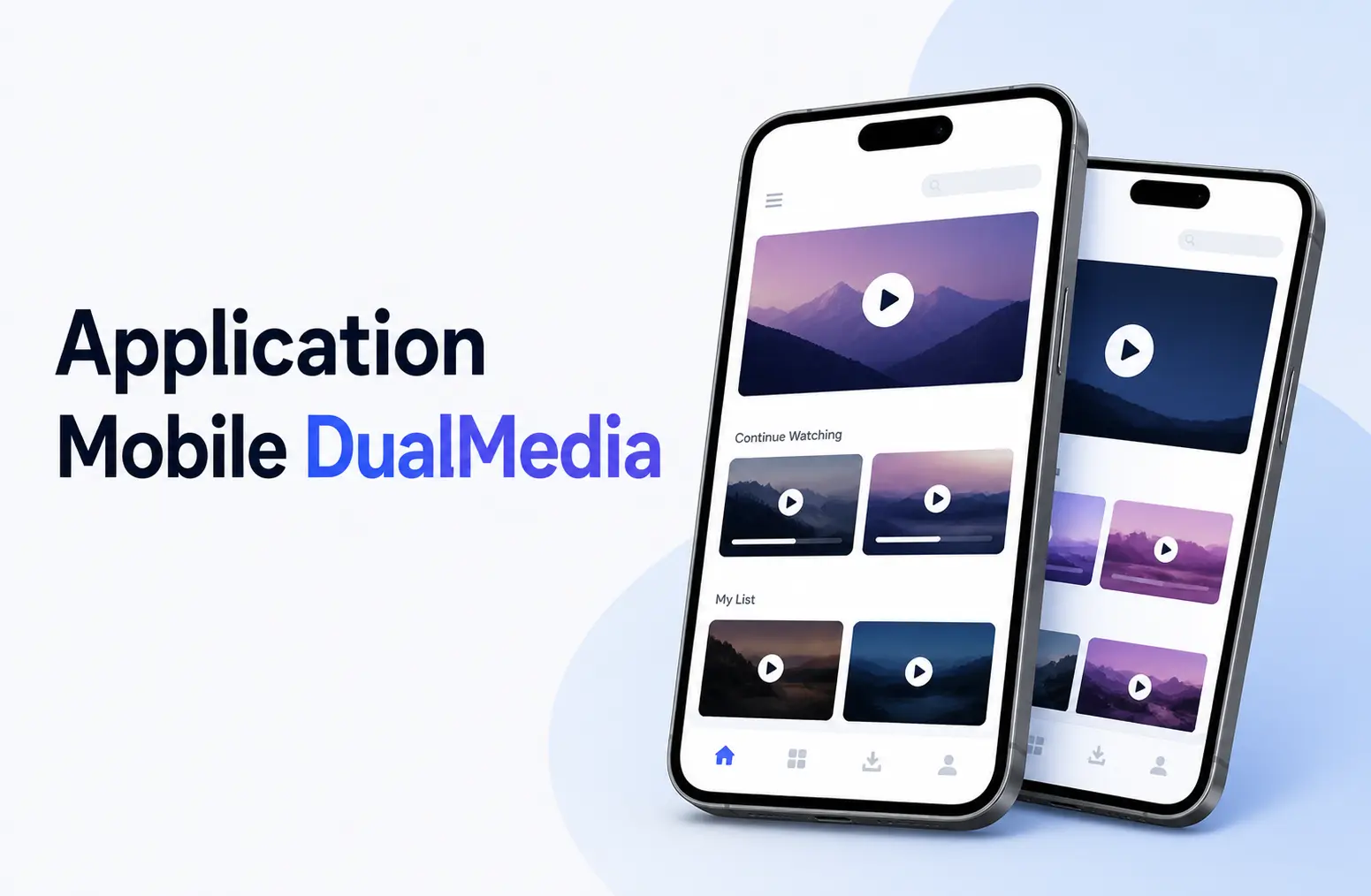
A mobile dualmedia application is an application in mobile devices where one can access various forms of media, such as video, audio, text, and images, in a single application. It is not necessary to alternate between various apps; it is all in one platform. It sounds convenient, but it eradicates a major problem that most users have to struggle with daily.
Let’s be honest. It is annoying to use various applications to perform various tasks. I have dealt with clients who lost users simply because their applications did not read a variety of formats without issues.
It is in this case that the development application mobile dualmedia comes in. It assists companies in developing a single strong application rather than a variety of low-quality applications that provide users with a seamless and holistic experience.
Why Application Mobile DualMedia growing fast in 2026?
To put it in simple words, it is the application that incorporates multiple types of media into one system. A content producer can use the app to film a video, strip it of audio, add subtitles, and post that without leaving the app, to name a few. This would involve several tools in the real world. All this is under one roof and has dualmedia app.
In my experience, the largest distinction relative to traditional apps is that of flexibility. The majority of apps are single-purpose applications. Dualmedia applications are designed to be used in real-world applications where users are always changing formats.
There has been a shift in user behavior. The content is no longer consumed in a single format. They view video, listen, read captions, and interact simultaneously. This change is being matched by companies.
I have personally experienced an amplification in user engagement as companies added support in multiple formats. The time your users spend on your app will increase as they will not need to leave. That increases retention and revenue straight up.
AI is also making its contribution. Other amenities, e.g., voice-to-text and smart editing, are also making their way to these apps, making them even stronger.
Read Also: TheGamelandnet
The main characteristics of the Application Mobile DualMedia
- Multi-Format Media Integration: All are included in a single platform: video, audio, text, and images. Users are not required to have separate tools.
- Unified Dashboard: An interface that is clean and has all the things in one location. This increases the usability and minimizes confusion.
- Live Interaction: Live streaming and real-time changing between formats. This can be of great assistance, particularly among the artists and teachers.
- Cloud Sync and Cross-Devices Use: Customers can start working on one device and proceed to another without losing their work.
- Security and Data Protection: The user information is safe with strong encryption and authentication.
Benefits of Using Application Mobile DualMedia
Saves time as it minimizes app switching. Improves user experience. Increases engagement. Reduces development costs. Opens up new monetization opportunities.
Personally, user satisfaction is the greatest advantage. Users are more at ease when everything is smooth in one location, and thus, they are likely to remain.
Development Of Application Mobile DualMedia (Step-by-Step)
- Step 1: Requirement Analysis: Know what types of media your app requires. Keep it focused.
- Step 2: Selecting the appropriate Tech Stack: Decide between native and hybrid development. A hybrid is good to scale faster in most instances.
- Step 3: Cloud and Backend: This is critical. Strong servers are needed to store and stream media apps.
- Step 4: UI / UX Design: Make the interface minimalist. Excessive features may disorient the users.
- Step 5: Media Integration: Trustworthy APIs with video, audio, and real-time communication.
- Step 6: Testing and Optimization: Test performance with caution. Unless optimized, media apps can be slow.
In my work on the development application mobile dualmedia, performance issues are the most common challenge. Reducing load speed and responsiveness is one of the factors that can significantly impact user retention.
My Personal Take Pro-Tip
Personally, I have found that most developers have an urge to include too many features simultaneously. I have witnessed apps fail due to their more feature-focused approach than performance. The number of tools you provide does not matter as much as the fact that users of your dualmedia app become confused or slow. I would just give plain advice. Take one good attribute, polish it, and turn it into something good. When that is functioning, then go bigger.
Hidden Features Most Blogs Don’t Mention
Certainly, some strong features tend to be disregarded:
- Instant switching between audio and video
- AI-powered auto captions and transcription.
- Contents repurposing tools in various formats.
- Built-in monetization systems
One time, we had an assignment to add auto captions, and I worked on it. The level of interaction was very high as users were able to watch content without audio.
Common Development Mistakes in DualMedia Apps (2026 Reality)
These are highly prevalent errors:
- Slow loading is caused by poor media compression.
- User drop-off is due to a lack of online support.
- The backend systems collapse during traffic.
- Complex design disorientation to users.
I have seen apps fail due to small performance issues. Any slight delay will drive users away. It is highly significant to fix these issues at an early stage.
Read Also: What Is Zvodeps?
Future Trends in Application Mobile DualMedia (2026 to 2028)
The future is bright. Artificial intelligence-driven editing solutions, real-time language translators, AR and VR content interactions, and recommendations of personalized content. When you are planning a development application mobile dualmedia, then you should think ahead. The users will be looking forward to smarter and faster apps in the future.
Who Should Use Application Mobile DualMedia?
- Content creators
- Startups and businesses
- Educators and trainers
- Media companies
This type of app can help anyone who deals with digital content.
Application Mobile DualMedia vs Traditional Apps
Conventional applications are limited to a single purpose. Dualmedia applications are multi-purpose applications. This ensures that they are more efficient and friendly to use. Users would like to use time- and energy-saving solutions.
FAQs
What is an application mobile dualmedia?
It refers to an application whereby the user is able to manipulate different types of media like video, audio, and text, in one place.
Do you find the development application mobile dualmedia difficult to use?
It is not as easy as just developing a basic application, but it might be handled with appropriate planning and the correct tools.
Is it possible to use dualmedia apps offline?
Yes, as long as offline functionality is included in the development.
Do they make such applications safe?
Yes, provided that it has been constructed with the right security features, such as encryption and authentication.
What is the cost per development of one?
Prices also differ based on features and complexity, but tend to be more expensive than basic apps.
Conclusion
Application mobile dualmedia is in demand, as users desire to have everything in the same location. They no longer want to alternate between apps. They desire to have speed, simplicity, and convenience. This kind of app provides just that.
In my experience, the success of development application mobile dualmedia is balanced. Be performance-oriented, make the design minimal, and create features that are actually useful to the user. When done well, you are not merely creating an app. Your solution will be used by people on a daily basis.
